Attractors
Attractors
Where Chaos Becomes ArtImagine standing at the edge of a river, watching how the current swirls in patterns that never quite repeat themselves, always familiar, never identical. What if you could capture that kind of dance, not as water, but as light and sound?
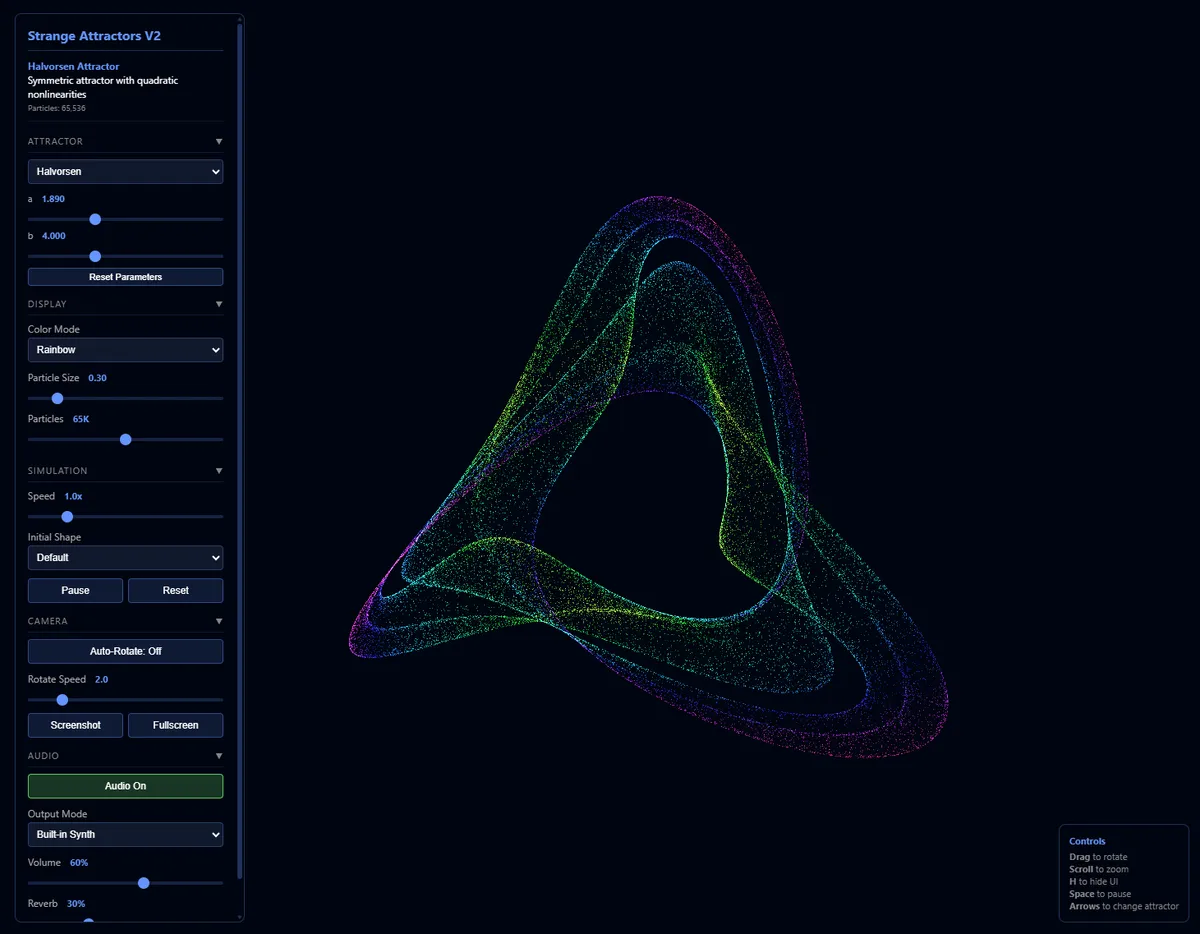
This project is a living instrument that does exactly that. A myriad of tiny glowing points drift through three-dimensional space, obeying mathematical laws first discovered by scientists trying to understand weather, plasma, and the rhythms of the natural world. These aren’t just equations, they’re the hidden choreography behind clouds forming and rivers branching. Each of the different “attractors” you can summon has a distinct visual signature: the famous Lorenz butterfly, spiraling Rössler bands, the four-lobed flower of a system called Four-Wing, Chua’s electric piecewise jumps. Switch between them and the entire cloud reorganises itself into a new shape, like watching a flock of starlings decide to become something else entirely.
What makes it more than a visualisation is that every particle is also singing. As the cloud moves, its motion is translated into sound, low drones from the particles drifting underneath, a warmer layer in the middle, melody from the brighter points above, and shimmer from the fastest ones at the very top. Where a particle sits left-to-right pans it across your ears. How fast it’s moving opens and closes a filter, making the sound brighter or darker. The result is four voices of continuously evolving granular music, grains of sound dusting together into clouds of harmony, that are the direct acoustic echo of the visual motion. Turn on MIDI output and the particles can play real instruments: a synthesiser across the room, a sampler, anything you want to plug in.
You don’t compose with this thing so much as you coax it. Adjust a parameter and the whole system tips into a new personality, more frantic, more serene, symmetric, twisted, sparse, dense. Hold on one attractor and you’re watching a single ecosystem unfold; cycle through them and you’re conducting eighteen different responses. The pentatonic scale keeps everything harmonious no matter what chaos the math is doing underneath, so it never feels random, only alive.
At its heart, this is a meditation on a paradox that artists and mathematicians both love: that deterministic systems, governed by fixed, knowable rules, can produce behavior so intricate and unpredictable that it feels authored, even soulful.
The attractor system is available for live exploration: attractors.virtualrichard.com